


Only a few years ago, industrial robots were mainly associated with large automotive plants, welding cells, and factories producing millions of identical parts.
Today, the picture is very different.
Robotization is becoming increasingly common in food and beverage production, packaging, logistics, pharmaceuticals, cosmetics, electronics, and many other industries where repetitive operations, labor shortages, or the need for a more consistent production rhythm are part of everyday reality.
The numbers reflect this shift. According to the International Federation of Robotics, around 542,000 new industrial robots were installed worldwide in 2024, more than twice as many as ten years earlier. The global operational stock has already reached approximately 4.66 million industrial robots.
But this does not mean that every manufacturer should simply “buy a robot.”
The real question is:
Which operation is worth robotizing, and how will the robot be integrated into the entire production process?
This is where the difference between an individual machine and a properly engineered automated system becomes critical.
An Industrial Robot Is Not a Standalone Solution
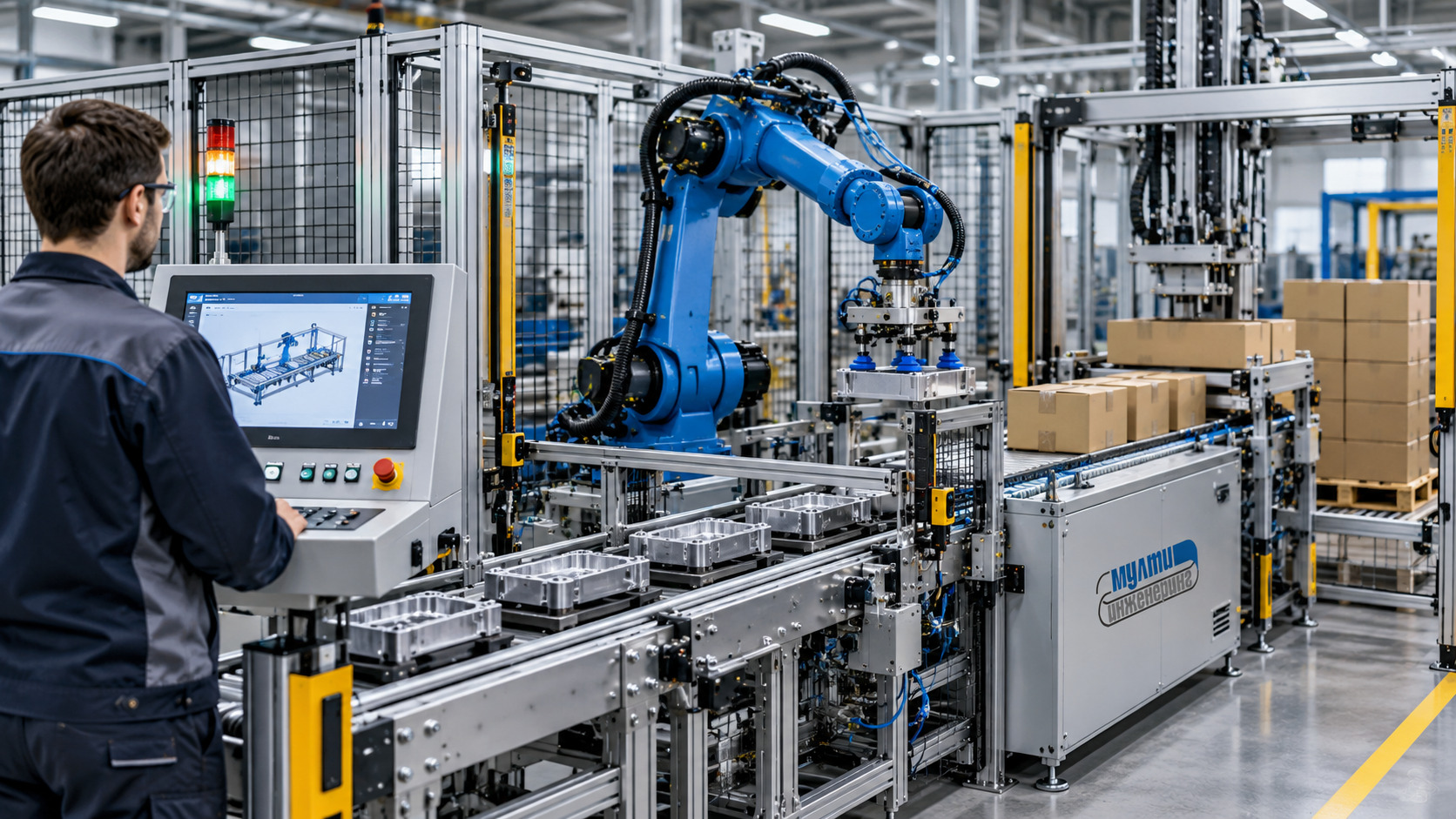
A robotic arm is only one component of the system.
To perform a real production task, it usually requires appropriate tooling, conveyors, sensors, safety systems, control equipment, a defined working area, and communication with both upstream and downstream machines.
That is why robotization should not be approached by looking only at the robot itself, but at the entire process.
MultiEngineering designs and manufactures automated production lines, conveyor systems, custom equipment, and manipulators for the automatic arrangement, sorting, separation, and feeding of different products.
This approach makes it possible to treat automation as an integrated system adapted to the real production environment rather than as a separate machine placed somewhere on the factory floor.
Why Are Industrial Robots Continuing to Expand Across Manufacturing?
The reason is not simply that robots are becoming more accessible or easier to program.
Manufacturers are looking for practical solutions to several persistent challenges:
- shortages of skilled workers;
- the need for greater production capacity;
- the demand for more consistent quality;
- excessive dependence on repetitive manual tasks;
- physically demanding operations;
- the need for safer and more predictable processes.
In 2026, European manufacturers continue to face difficulties recruiting workers with the right skills. This makes robotization increasingly less about technological prestige and more about how production is organized.
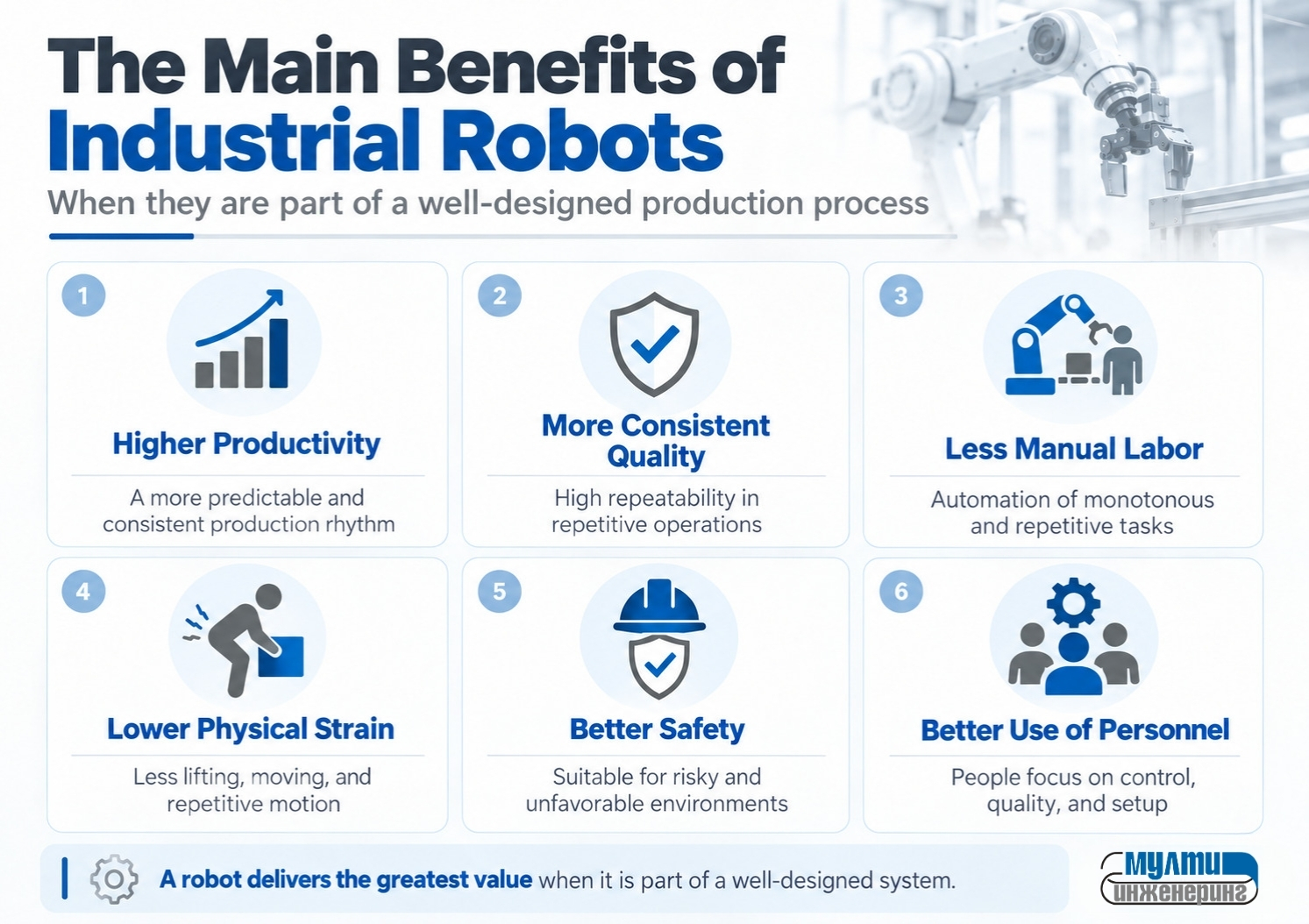
1. Taking Over Repetitive Operations
Almost every manufacturing facility includes tasks that must be repeated hundreds or thousands of times during a shift.
Pick up a product.
Rotate it.
Move it.
Position it.
Place it in a box.
Stack it on a pallet.
Repeat.
These are exactly the types of operations where automation can deliver significant value.
When the operation is clearly defined, a robot can perform the same sequence consistently without the quality of the movement being affected by fatigue toward the end of a shift.
For employees, this can mean moving away from monotonous physical work toward process supervision, machine setup, quality inspection, material loading, or other tasks where human judgement provides greater value.
2. More Stable Productivity
One of the main advantages of robotization is predictability.
When the cycle time of an operation is known, it becomes much easier to calculate the expected production capacity per hour or per shift.
This becomes especially important when the robot is integrated into an automated production line. Its speed must be synchronized with the conveyors, upstream machinery, and downstream processes.
Installing a faster robot does not automatically make the entire production line faster.
If the previous machine cannot supply enough products, or the following process cannot handle the robot’s output, the robot will simply wait.
That is why productivity should be evaluated at the level of the entire production line, not only by looking at the technical specifications of the robot.
3. More Consistent Quality and Repeatability
Some manufacturing tasks require almost identical movements to be performed every single time.
Examples include:
- positioning a component;
- placing a product;
- dispensing;
- assembly;
- transferring parts to another machine;
- arranging products inside packaging;
- building a pallet pattern.
When properly programmed and integrated, a robotic system can provide a high level of repeatability.
This does not mean that the robot automatically guarantees the quality of the final product. Quality still depends on incoming materials, machine settings, tooling, sensors, and the rest of the production process.
However, a well-designed robotic system can remove one important variable: differences in how the same repetitive operation is performed.
4. Reduced Physical Strain for Employees
Not every physically demanding operation involves lifting extremely heavy loads.
An employee may only be lifting 5 or 10 kilograms at a time — but doing it hundreds of times during the working day.
It is often the repetition that makes the task physically demanding.
A robot or specialized manipulator can take over lifting, moving, rotating, and positioning products, boxes, components, or other materials.
MultiEngineering develops manipulators for automatic arranging, sorting, separating, and feeding of products with different shapes and dimensions. These are precisely the types of operations where automating movement can significantly improve the way a workstation is organized.
5. Robotization in Challenging Working Environments
High temperatures, dust, fumes, hazardous tools, repetitive lifting, and working close to moving machinery are all situations where automation may be worth considering.
However, simply installing a robot does not automatically make the process safe.
A robotic cell must be engineered with a proper risk assessment, suitable guarding or protective devices, emergency stops, access control, and the correct safety logic.
In 2026, safety, cybersecurity, and standards remain important topics in the development of industrial robotics.
Safety should therefore not be treated as an accessory added after installation. It must be part of the engineering process from the very beginning.
Where Are Industrial Robots Used?
Industrial robots are no longer limited to welding operations in automotive manufacturing.
Their applications now cover a much wider range of industries and production processes.
Pick and Place
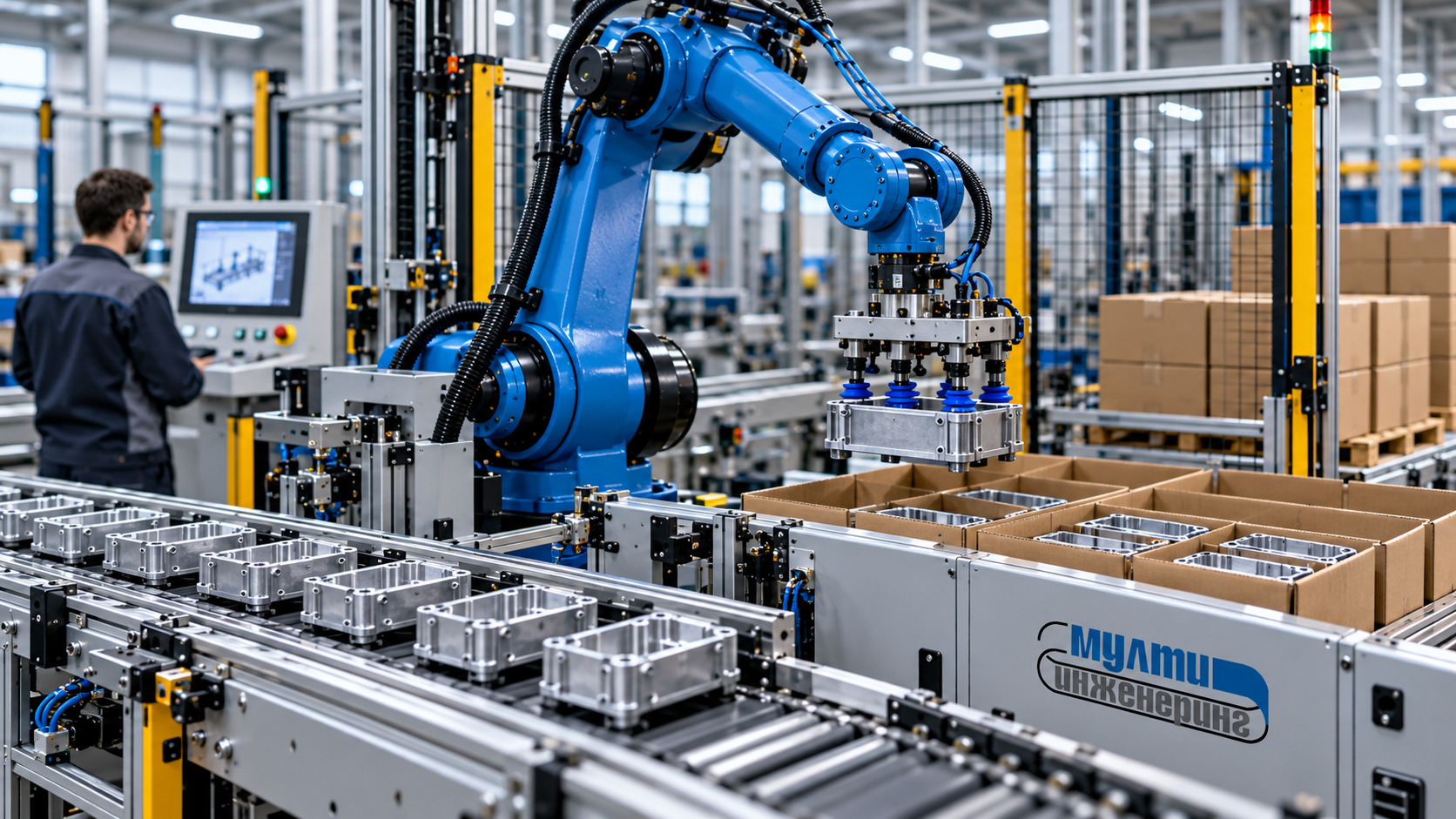
One of the most common applications is picking a product from one position and placing it in another.
Products may arrive on a conveyor, after which the robot can:
- distribute them;
- rotate them;
- sort them;
- place them in packaging;
- arrange them in crates;
- feed them into another machine.
In such applications, the connection between the robot and the conveyor system is particularly important.
The conveyor does not simply deliver products to the robot. It determines the speed, positioning, and rhythm of the entire process.
Palletizing
Stacking boxes, bags, or other products onto pallets is a classic example of an operation with strong potential for robotization.
The reason is straightforward: the movement is highly repetitive, product dimensions are usually known in advance, and the physical load increases significantly over hundreds or thousands of cycles.
A properly designed palletizing system, however, involves much more than the robot itself.
It may also require:
- an infeed conveyor;
- product orientation;
- positioning;
- empty pallet feeding;
- safety guarding;
- removal of completed pallets.
Packaging
Robotic systems can be integrated before, after, or directly within a packaging machine.
For example, the robot may group products, place them into cartons, or transfer finished packages to the next production stage.
At high production volumes, synchronization becomes essential.
If products are continuously arriving faster than the robot can handle them, accumulation will occur. In such cases, buffer zones may be incorporated into the line to provide temporary accumulation and support more stable operation between different processes.
Machine Tending
A robot can load a component into a machine, wait for the operation to finish, remove the processed part, and load the next one.
This is particularly suitable for highly repetitive production cycles where an operator would otherwise perform almost the same movement throughout the entire shift.
Sorting and Feeding
The combination of conveyors, sensors, robots, and manipulators allows products to be separated and directed toward different processes.
This is particularly useful for production lines that handle multiple products, sizes, or formats.
Can the Robot “See”?
Increasingly, yes.
Machine vision allows automated systems to receive information from cameras and identify characteristics such as product position, orientation, or specific visual features.
This can be especially useful when products do not always arrive in exactly the same position.
In 2026, robotics development is going even further. Artificial intelligence, including generative and agentic AI, is increasingly being explored as a way to help robots interpret their surroundings, process information, and adapt to more complex tasks.
For most real industrial applications, however, one practical question remains more important than the technology itself:
Is this technology actually necessary for the task?
If a product always arrives in the same position and orientation, a complex machine vision system may not be needed.
Good automation does not use the maximum amount of technology possible.
It uses exactly as much technology as is required to solve the task reliably.
Industrial Robots in 2026: From Standalone Machines to Connected Systems
One of the important trends in modern manufacturing is the convergence between information technology and operational technology.
In practice, this means greater information exchange between robots, machines, sensors, control systems, and software.
An industrial robot should no longer be seen as an isolated arm that simply performs a programmed motion.
It can become part of a system that knows:
- whether a product has arrived;
- whether the next machine is ready;
- whether a buffer is full;
- which product is currently being processed;
- whether the operation was completed successfully;
- when the next component should be released.
This is where robotization becomes part of the broader concept of an automated production line.
Does Robotization Necessarily Mean Fewer People?
This is one of the most common questions surrounding automation.
In many cases, the objective is not simply to “replace a person,” but to automate a specific task.
The most suitable tasks are often those that are:
- repetitive;
- physically demanding;
- uncomfortable;
- monotonous;
- hazardous;
- limiting the capacity of the production line.
At the same time, automated systems still need to be configured, supervised, maintained, and optimized.
Robotization therefore also changes the type of skills required in manufacturing.
Rather than spending an entire shift manually transferring products, employees may increasingly supervise equipment, manage changeovers, perform quality checks, solve process problems, and maintain automated systems.
What Are the Disadvantages?
An industrial robot is not a universal solution.
The initial investment can involve considerably more than the robot itself.
A complete project may include:
- engineering and design;
- end-of-arm tooling;
- supporting structures;
- conveyor systems;
- electrical equipment;
- control systems;
- sensors;
- safety systems;
- programming;
- installation;
- commissioning and optimization.
After implementation, the system will also require maintenance, spare parts, employee training, and potentially future modifications.
For this reason, the investment must always be evaluated against the specific production operation.
If production involves very small and constantly changing batches, if the product is difficult to standardize, or if the operator performs many completely different tasks, full robotization may not always be the most practical solution.
In some cases, a simpler manipulator, conveyor system, or partial automation solution can deliver a better result.
How Do You Know Whether an Operation Is Suitable for Robotization?
A useful starting point is to ask several practical questions:
- Is the operation repeated continuously?
- How long does one cycle take?
- How many products must be processed per hour?
- Does the task create physical strain for employees?
- Is consistent positioning or repeatability important?
- Is this operation limiting the production line’s capacity?
- Is the incoming product flow sufficiently predictable?
- How will the robot communicate with the other machines?
- What happens if the upstream or downstream machine stops?
- How often does the product or format change?
The answers often reveal whether the problem requires an industrial robot, a specialized manipulator, or another form of automation.
How Robotized Is Manufacturing in 2026?
The latest complete global data illustrate the scale of the change.
Around 542,000 industrial robots were installed worldwide in 2024, with annual installations remaining above half a million units for the fourth consecutive year.
Europe installed approximately 85,000 industrial robots during the same period, remaining one of the world’s most highly automated manufacturing regions.
Another important indicator is robot density — the number of operational industrial robots per 10,000 manufacturing employees.
In 2024, Western Europe reached approximately 267 robots per 10,000 manufacturing workers.
However, this does not mean that every company should aim for the maximum possible number of robots.
The more important question is:
Where does automation create real value?
Do Not Start With the Robot. Start With the Problem.
This may be the most important principle of all.
Not:
“We want a robot. Where can we put it?”
But:
“We have this production operation. How can we make it faster, safer, and more predictable?”
In one case, the answer may be a six-axis industrial robot.
In another, it may be a manipulator.
In another, a conveyor with sensors.
In another, a buffer zone.
And sometimes the best solution is a combination of all of them.
How Does MultiEngineering Approach Automation?
Automation delivers the greatest value when it is designed around the actual production process.
MultiEngineering develops and implements automated production lines, conveyors, transport systems, manipulators, special-purpose machines, and custom technological equipment.
The company works with solutions for the food and beverage industry, light manufacturing, packaging, bottling, meat processing, cosmetics, pharmaceuticals, and other industrial applications.
This is especially important in robotization because the robot rarely works alone.
Before the robot, products need to be fed correctly.
After the robot, they need to be transferred correctly.
Between the processes, there must be synchronization.
Around the robot, there must be suitable structures, controls, and safety systems.
The real value is not that the robot moves quickly. The real value is that the entire production process works better.
Conclusion
Industrial robots are no longer a technology reserved only for automotive giants.
In 2026, they are part of a much broader transformation in manufacturing — more automation, more connected machines, less dependence on repetitive manual labor, and greater focus on the stability of the entire production process.
But robotization should not begin by choosing a robot model.
It should begin with an analysis:
Where are we losing time?
Where are products accumulating?
Where is an operator repeating the same movement hundreds of times?
Which operation is limiting production capacity?
Only then can the right solution be engineered.
If your production process includes a repetitive, physically demanding, or capacity-limiting operation, MultiEngineering can analyze the process and develop an automated solution tailored to your specific production environment.


